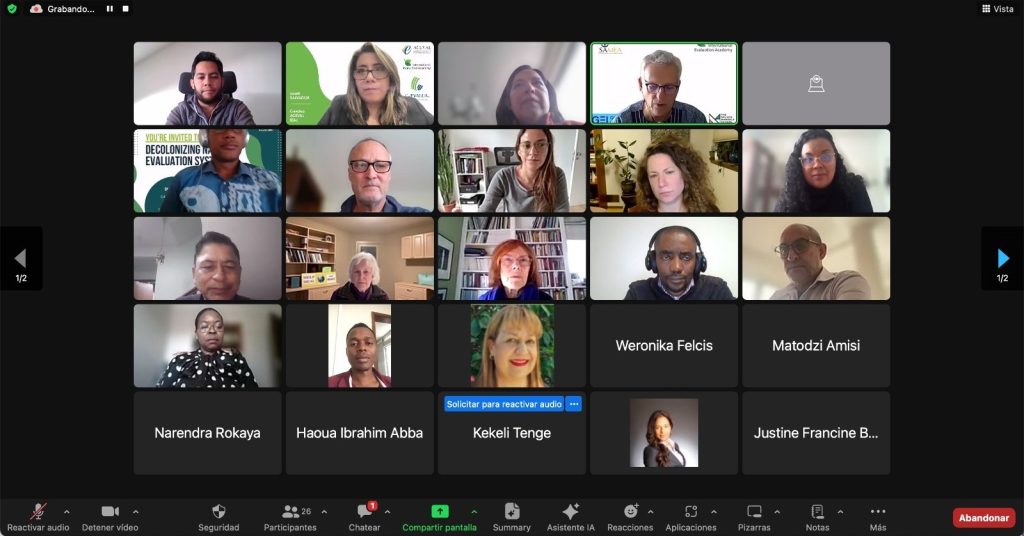
Note: Partial view of participants attending the webinar “Decolonising National Evaluation Systems”, held on 1 November 2023.
Following from the work on Decolonising Evaluation, a group of
people led by Candice Morkel and Ian Goldman involved in national evaluation
systems brought together a group to explore the implications of the
decolonisation thinking for this work.
This initial thinking was explored in a webinar
in November
- Allowing
NESs to break from historical forms of bureaucratic functioning;
- Developing
a systems-based approach as the basis for new thinking around NESs,
strengthening their ecological aspects;
- Embracing
the learning approaches we see in both countries;
- Embracing
principles of participatory democracy and co-production by strengthening
the voice of non-state actors, particularly citizens, in the formation of
NESs and
- Changing
power dynamics, in NESs and evaluations.
Subsequently this work has been written up for a Global Environment
Facility book based on the 2024 conference which will be available in mid 2026.
The chapter is called ‘Shifting power and perspectives in evaluation systems to
address the polycrisis’, Chapter 11 in
Batra, G, Uitto, J.I., & Spearman, M.A., (eds), 2025 forthcoming,
‘Integrating for Sustainability: Evaluation Across Environmental and
Socioeconomic Domains’, Springer. Co authors are Goldman, I, Molaiwa, T.,
Agbodjan, E.D., Gounou, A., Bowman, N., Belzer, A., Morkel, C. (2025).
In 2025 work was led by Thokozile Molaiwa, Head of the South
African Evaluation System, with Ian Goldman. It has focused on areas of
practical application of these ideas:
- Revising the South African National Evaluation
Policy Framework to incorporate the thinking of how to improve
effectiveness in contributing to the polycrisis. This includes advancing
the two evaluation criteria developed in South Africa on Transformative
Equity and Climate and Ecosystems Health; strengthening the voice of users
and those affected in evaluations and the evaluation system; and
introducing rapid evaluations to enhance agility, responsiveness, and
foresight.
- Piloting using MadeinAfrica evaluation approaches
in an evaluation of the Development Bank of Southern Africa
- Discussions have also been held with Benin on
supporting a local government evaluation system
Links to:
- Decolonizing National Evaluation Systems article
- Decolonizing National Evaluation Systems blog
- Decolonizing National Evaluation Systems webinar (November, 2023)
- Decolonizing National Evaluation Systems (December, 2024)
- Revised NEPF link